COAST
Where the country meets the coast: Middleton
A guide to the Fleurieu's quietest stretch of shoreline, where pasture rolls straight down to the swell.
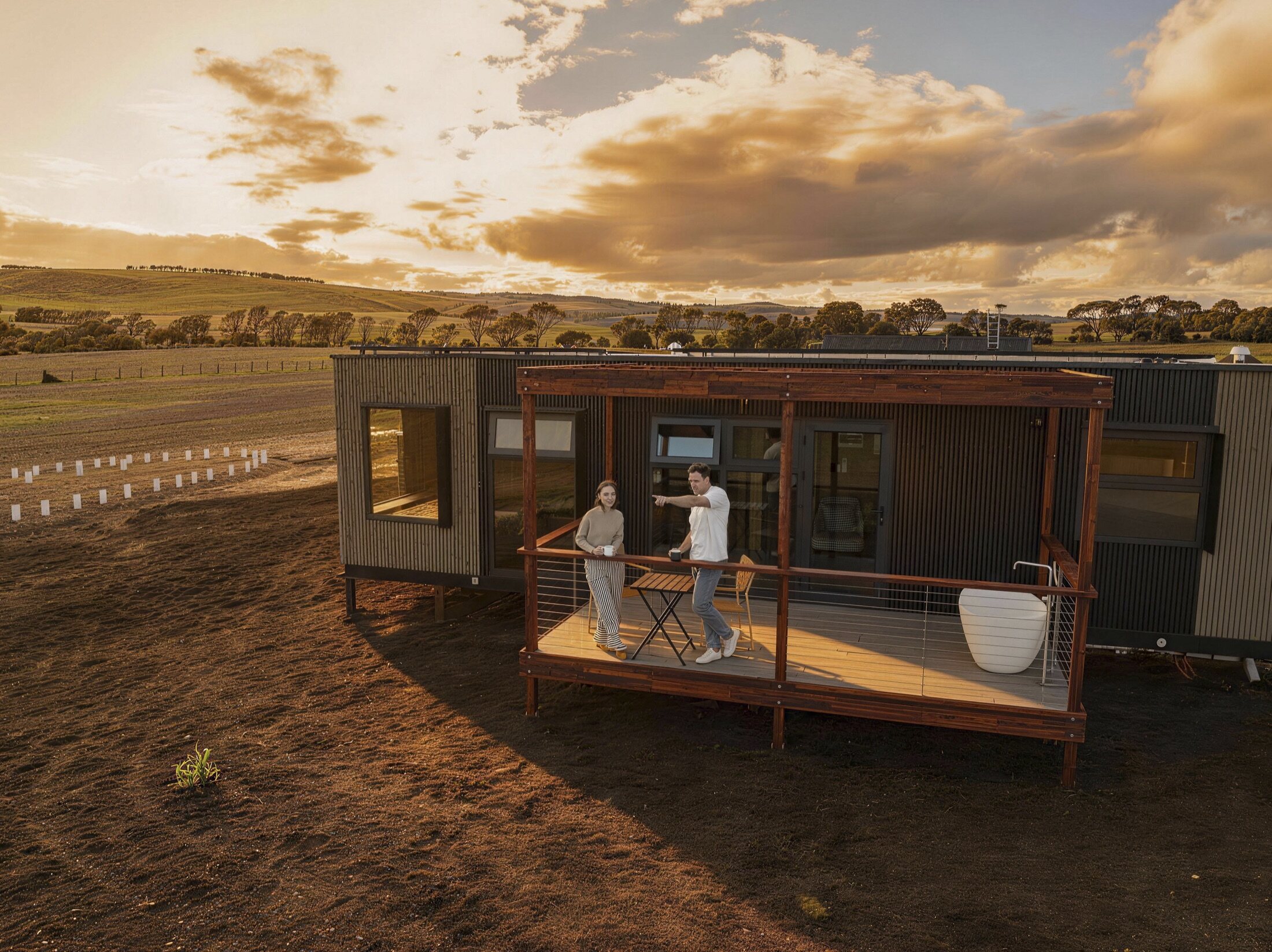
There is a particular feeling on the Fleurieu Peninsula, about ninety minutes south of Adelaide, where the farmland does not so much end as tip over. Pasture runs green and grazed to the edge of a low cliff, and then there is nothing but the Southern Ocean, grey-blue and working, all the way to Antarctica. Middleton sits exactly on that seam. It is a small town on the Encounter Coast, between Port Elliot and Goolwa, and it has the rare quality of being two landscapes at once: the back paddocks of the Adelaide Hills hinterland on one side, the open swell of Encounter Bay on the other.
Most visitors to South Australia's south coast aim straight for Victor Harbor and its causeway, or push on to the Coorong. Middleton tends to get passed through. That is part of its appeal. It rewards the traveller who slows down enough to notice the way the light changes over the dunes through an afternoon, and who is content to organise a day around the tide and the wind rather than a list of attractions.
A surf town that never got loud
Middleton has been a surfing town for decades, and it wears the reputation lightly. The break at Middleton Point throws up long, forgiving waves over a wide sandy bottom, which is why it has become one of the most reliable learner beaches in the state. On a clean morning you will see a line of beginners being pushed into their first whitewater alongside longboarders carving the same gentle walls. It is not a place of dramatic barrels and territorial line-ups; the mood is generous, almost communal.
The beach itself is long and uncrowded, backed by hummocky dunes and the granite that defines this coast. You can walk for an hour and pass only dog-walkers and the occasional fisher. The water is honest about its temperature — this is the Southern Ocean, after all — but on a still day the bay flattens into something close to serene, and the whole place feels like it is holding its breath.
The named encounter
Encounter Bay carries its history in its name. In April 1802, the English navigator Matthew Flinders, charting the coast in the Investigator, met the French expedition under Nicolas Baudin sailing the other way. The two captains, whose nations were at war, paused mid-survey to exchange information like colleagues. Flinders named the meeting place Encounter Bay, and the label has held for more than two centuries. Standing on the headland with the wind coming off the water, it is easy to feel how exposed and consequential that stretch of coast must have seemed to men in timber ships.
That sense of edge is literal. This is one of the southernmost faces of the Australian mainland, fronting open ocean rather than a sheltered gulf, and the weather arrives with little warning. Locals read the sky the way other people read a watch.
Whales, granite and the river's end
From roughly May to October, southern right whales come into Encounter Bay to calve and rest, having travelled up from the sub-Antarctic. They were hunted close to extinction here in the nineteenth century, when the bay held one of the colony's earliest whaling stations; now they return each winter as the coast's quiet spectacle. From the granite headlands around Middleton and neighbouring Port Elliot, patient watching is often repaid with a tail or a spout, sometimes a full breach close to shore.
The granite is worth noticing in its own right — rounded grey boulders piled at Port Elliot's Horseshoe Bay, a near-perfect crescent of sand a few minutes east. West, the land flattens towards Goolwa, where the River Murray finally reaches the sea at the Murray Mouth, the slender outlet that feeds the Coorong's long lagoon system. Goolwa keeps its paddle-steamer heritage close; the river that built inland Australia ends, undramatically, in a shifting sandbar and a great deal of birdlife.
How to spend the day
The best plan for Middleton is barely a plan at all. Check the tide chart and the wind, then build the hours around them: a morning surf or beach walk when the swell is up, a drive to Goolwa or the Coorong when the weather turns, a winter afternoon on the headland looking for whales. The Fleurieu's wineries and the cellar doors of McLaren Vale lie within easy reach inland, so the coast and the country can be folded into a single unhurried day.
It is the kind of landscape that asks for stillness rather than itinerary. AUTRA's cabins on this stretch are built around that idea — placed where the pasture meets the dune, oriented towards the swell, so that the rhythm of the day is set by the light and the tide rather than the clock. Spend a night here and you understand the town's quiet confidence: it has the ocean on one side and the farm on the other, and it has never felt the need to be anything more than the meeting of the two.