NATURE
Under the darkest skies: Kangaroo Island
Why the island's near-total darkness makes for the most extraordinary stargazing in the Southern Hemisphere.
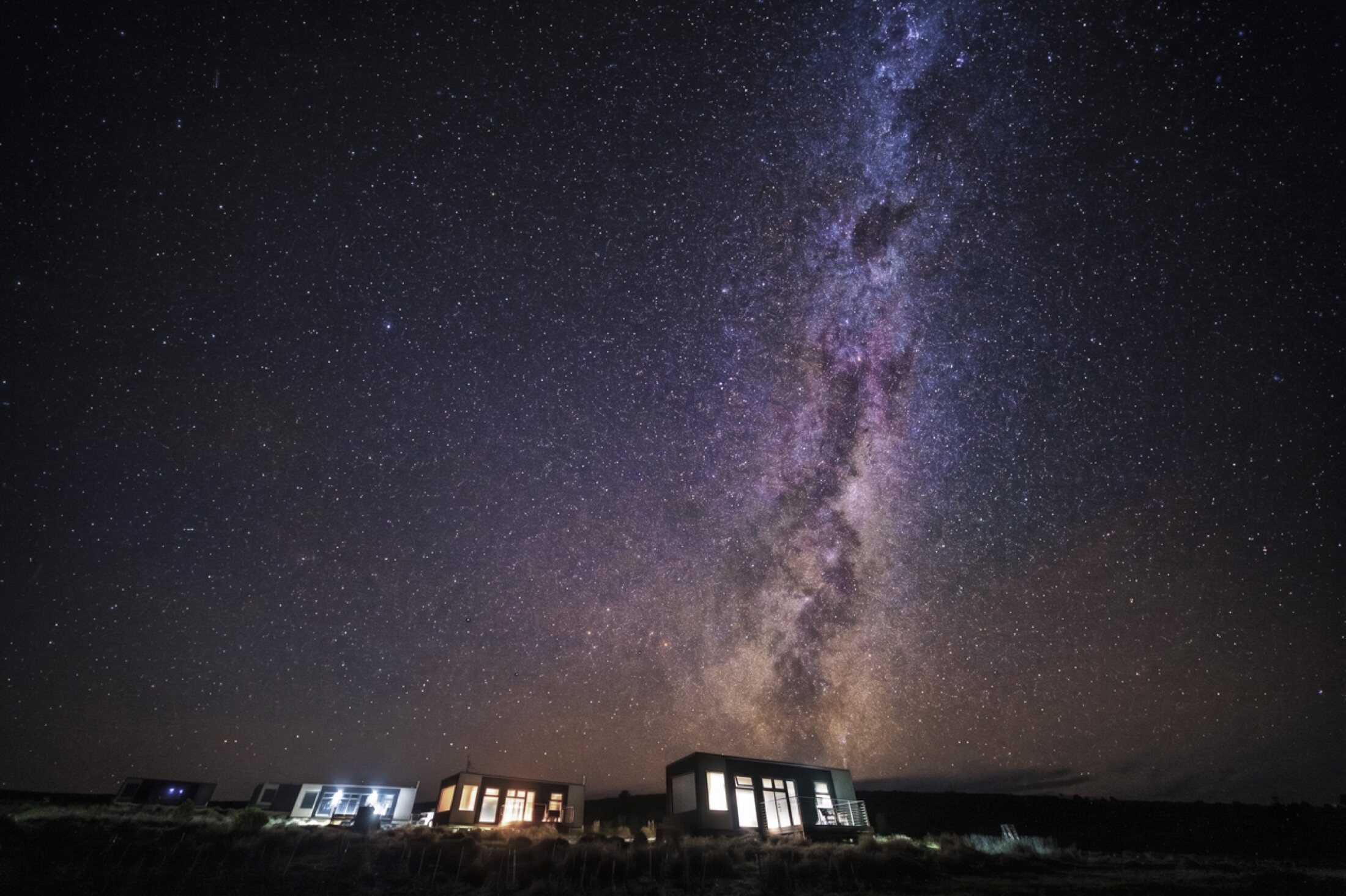
The crossing tells you something before the island does. From Cape Jervis the ferry pushes out across Backstairs Passage, a stretch of water that earned its weather long ago, and forty-five minutes later the ramp comes down at Penneshaw. You have travelled a short distance and a long way. Mainland glow falls behind. The towns here are small and far apart, the roads quiet after dark, and the result is a sky most people have simply never been shown.
We talk about Kangaroo Island for its wildlife and its coast, and rightly so. But the thing that stays with many guests is something they didn't come for: the hours after sunset, when there is almost nothing to compete with the stars and the whole arrangement overhead finally becomes legible.
What darkness actually does
Light pollution is subtractive. It doesn't add anything to a night sky; it erases. Under a city's orange dome you might count a few dozen stars and call it a clear night. The sky was always there — you simply couldn't see most of it. On much of Kangaroo Island, with so few people and so little artificial light spilling upward, the erasing stops. The faint stuff returns: the soft band of the Milky Way, the dust lanes inside it, the smudges that turn out to be other galaxies entirely.
The island has no formally certified dark-sky reserve, and there's no need to oversell it as the darkest place on Earth. What matters is plainer and more useful — across large parts of it, on a moonless night, the conditions are genuinely excellent, and excellent is all you need to see things that are otherwise invisible to most of us for an entire lifetime.
Reading the Southern Hemisphere sky
Start with the brightest feature. When the galactic core of the Milky Way is up, it dominates — a thick, mottled river of light running across the sky, far more textured than the thin wash visible from suburbs. The core rides highest in the southern winter months, roughly autumn through spring, climbing the evening or pre-dawn sky depending on the season. Summer offers a quieter Milky Way but darker, longer nights have their own reward.
Then the navigation marks. The Southern Cross — Crux, the small, tight cross printed on Australia's flag — sits embedded in the Milky Way, and nearby blaze the two Pointers, Alpha and Beta Centauri. Alpha Centauri is the closest star system to our own, which is a strange thing to hold in your eye. Trace a line through the Cross and down toward the horizon and you've found roughly true south, the same trick used long before compasses.
Lower and off on their own float the Magellanic Clouds, two pale patches that look like torn pieces of the Milky Way but are separate dwarf galaxies, satellites of ours. Within Crux and Carina you can pick out the Carina Nebula, a vast stellar nursery, brighter and larger than the more famous Orion Nebula but rarely mentioned because so few northern observers ever get to see it.
The Emu in the Sky
There is an older way of reading this sky, and it inverts the European habit entirely. For many First Nations peoples across Australia, one of the great constellations is made not of stars but of the dark dust lanes within the Milky Way — the Emu in the Sky. Its head is the dark Coalsack nebula beside the Southern Cross; its neck and body stretch along the dark river toward Scorpius.
You see it only where the sky is dark enough for the dust to read as shape rather than absence, which is precisely why a place like this matters. The emu’s position through the year tracked seasonal cues, including the breeding and egg-collecting times of real emus on the ground. It is astronomy and calendar and country at once, and it asks you to look at the gaps between the stars rather than the stars themselves.
How to actually see it
The single biggest factor is the Moon. Check its phase and aim for the nights around new moon, or the windows before it rises or after it sets — a bright moon washes out the faint detail as effectively as any streetlight. After that, give your eyes time. Full dark adaptation takes twenty to thirty minutes, and a single glance at a phone undoes it in an instant. Use a red light if you need to see your feet; switch the screen to its dimmest red mode, or simply put it away.
Dress warmer than you think — clear nights are cold nights, since the same cloudless sky that lets you see the stars lets the day's heat escape. Lie back rather than craning your neck. Binoculars reveal more than you'd expect, sweeping up star fields and resolving the Magellanic Clouds, but the unaided eye under a truly dark sky is the real instrument. This is also the quiet argument for staying off-grid: our cabins on the island sit away from town light, and the walk from the door to full darkness is measured in steps, not kilometres.
There is a particular humility in it. You stand on a small island, on a thin coastline, looking out past the nearest star and the edges of our own galaxy, and the scale rearranges you a little. Most nights of your life the sky keeps this to itself. Here, for a few dark hours, it doesn't — and that, more than any single constellation, is what people carry back across the passage.