DESIGN
Designing for calm: inside an Autra cabin
The materials, light and restraint that go into a space built for doing very little, very well.
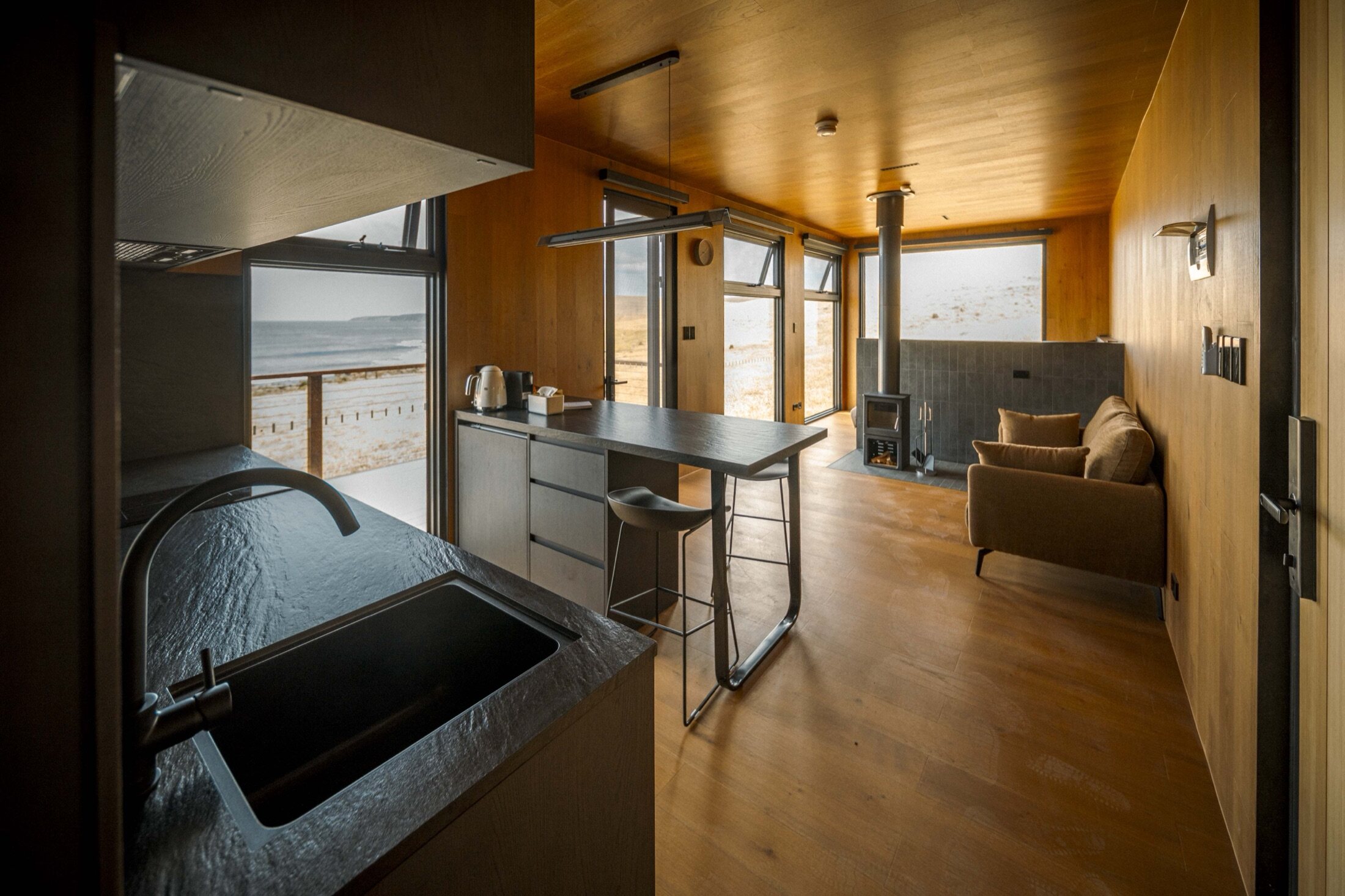
Calm is not a colour you paint on a wall. It is the sum of a hundred decisions, most of them about what to leave out. A cabin that feels restful when you walk in did not get there by accident, and it rarely got there by adding things. It got there by an architect drawing a line and then drawing it again, shorter.
An Autra cabin is small by design and generous by intention. The two are not in tension. When a building is asked to do less, every remaining element can be chosen with more care. This is the principle that runs underneath everything else here: restraint is not austerity, it is attention paid where it counts.
A short list of honest materials
The palette is deliberately narrow. Timber, linen, stone, blackened steel. Four materials carry most of the building, and each was chosen because it tells the truth about itself and ages without apology. Oiled timber darkens where hands touch it. Linen softens with every wash. Blackened steel develops a quiet, uneven surface that no factory finish can fake. Stone simply does what stone has always done.
Designers call this patina, and it is the opposite of the disposable. A surface that improves with use removes a small, constant anxiety from a room: the worry about marking it. You can put a wet glass down. You can lean. The cabin is built to absorb a life rather than resist one, and that permission is felt long before it is understood.
Letting the landscape in
South Australia gives you something worth framing. The vine rows of the Barossa around Lyndoch, the long grey light off the Southern Ocean at Middleton, the unhurried scrub and coastline of Kangaroo Island. A large window is not a feature so much as an editing tool: it decides which part of that to keep and holds it still, like a painting that changes through the day.
Orientation does the quiet work behind the glass. In the Southern Hemisphere the low winter sun comes from the north, so the main living space and its widest openings face that way. The cabin warms itself through the cold months and a deep eave keeps the high summer sun off the floor. This is passive solar design, and when it is done well you never notice it; you only notice that the room is the right temperature without anyone having asked it to be.
Why off-grid makes the calm
Each cabin runs on its own solar array and stores its own rainwater. The instinct is to read this as sacrifice, but the constraint is precisely what produces the stillness. A building that makes its own power has a natural ceiling on how much it can hum, glow and blink. There is no street light, no neighbouring compressor, no standby diode pulsing in the dark. The off-grid limit quietly edits out the low electrical noise that fills an ordinary home.
Acoustic quiet matters as much as the visual kind, and it is easy to underrate. Soft surfaces, the absence of hard parallel walls bouncing sound, and a site chosen for its distance from roads all lower the floor of ambient noise. Once that floor drops, smaller sounds return: wind moving through dry grass, rain finding the tank, a fire settling. You did not turn the volume up. You took your hand off the dial.
Thresholds that slow you down
Calm is partly choreography. The design uses thresholds to change your pace without instructing you. A deck between the living room and the open ground is a place to pause before you commit to the day. A fire, indoors or out, is the oldest threshold of all; people slow down near one and tend to put their phones away of their own accord. None of this is enforced. The room is simply arranged so that the restful choice is the easy one.
Biophilic design is the formal name for this pull toward the living world, but the experience needs no label. A view held open, daylight that moves, materials that came from the ground and will return to it, a temperature governed by the sun rather than a thermostat. The body recognises these as familiar long before the mind names them, and it settles.
What you are left with is a space that asks very little of you and, in return, asks you to do very little. The clutter has been designed out, the screens have nowhere obvious to live, and the building keeps making its quiet case for slowness. That is the whole ambition of an Autra cabin: not to impress you, but to get out of your way, so that the place itself, and the long afternoon in front of you, can finally be the most interesting thing in the room.