WINE
A weekend in the Barossa
Two days of cellar doors, long lunches and slow drives through one of the world's oldest vine country.
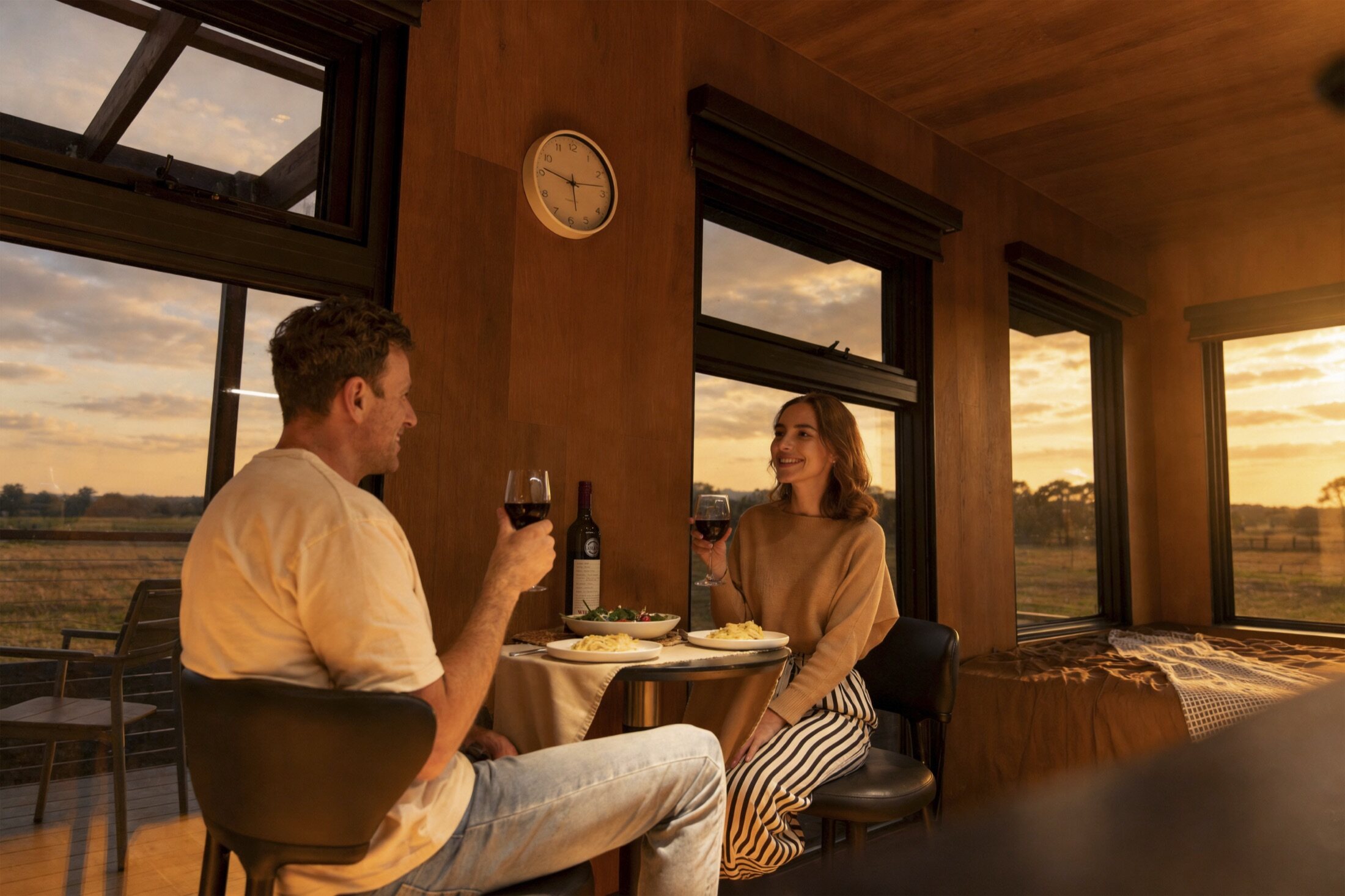
The Barossa sits about an hour northeast of Adelaide, close enough to reach before dinner on a Friday and far enough that the city falls away somewhere past Gawler. The valley is not large. You can drive its length in twenty minutes, which is precisely why it rewards the opposite instinct: stay put, eat slowly, and let two days unspool at the pace of a long lunch.
What makes this corner of South Australia unusual is age. While much of the world's vineyard stock was wiped out by phylloxera in the late nineteenth century, the Barossa was spared. Some of its Shiraz vines were planted in the 1840s and are still fruiting today, which means a glass poured here can carry a lineage older than most countries' wine industries. That continuity is the thread worth following across a weekend.
Friday: arrive, then stop
Settle in before you do anything else. Our cabins at Lyndoch, at the valley's southern entrance, make a quiet base — close to the cellar doors but angled toward the paddocks rather than the road, which is the whole point of arriving in the dark and waking to vines instead of traffic.
If there’s daylight left, drive up Mengler Hill before dinner. The lookout, between Tanunda and Angaston, gives you the valley in one frame: the patchwork of vineyards, the gum-lined creeks, the small towns laid out in the orderly grid the early settlers favoured. It is the best ten-minute orientation you can give yourself, and the light at the end of the day does the work no map can.
Saturday: market, then the old vines
Start at the Barossa Farmers Market in Angaston, held Saturday mornings in a former cattle yard at Vintners. It runs early and winds down by late morning, so go before the day warms. This is where the valley's German and Silesian Lutheran heritage shows up most plainly — in the smallgoods, the rye breads, the mettwurst and dill cucumbers that trace back to the families who settled Bethany, Tanunda and Angaston in the 1840s. Buy breakfast and eat it standing up among the growers.
Then go and stand in front of something old. Langmeil, in Tanunda, keeps a Shiraz block called the Freedom vineyard, planted in 1843 and among the oldest continuously producing Shiraz in the world. Tasting the wine is one thing; walking out to the gnarled, low-trained vines is another. They are not picturesque in the manicured sense — thick, dark, almost driftwood-like — but they carry the entire argument of the region in their trunks.
From there it is a short drive to Seppeltsfield, approached down an avenue of date palms planted during the Depression. The estate is best known for its Centenary Collection of Tawny — a fortified wine of which it releases a vintage exactly one hundred years old each year, an unbroken line stretching back to 1878. You can taste a wine from your birth year here, which is a strange and moving thing to do on a Saturday afternoon.
The long lunch
Lunch in the Barossa is not a refuelling stop; it is the centre of the day, and it deserves the hours. Hentley Farm, near Seppeltsfield, serves a set menu in a restored 1840s cottage with the vineyard at the door — book well ahead. FINO at Seppeltsfield leans Mediterranean, generous and unhurried. In Tanunda, Vintners Bar & Grill has been a reliable institution for years, the kind of room where a two-hour booking quietly becomes three.
Leave room, or leave a day, for Maggie Beer's Farm Shop near Nuriootpa. It is part shop, part pantry, set on a dam where black swans drift past the verandah. Pâté, verjuice, ice cream eaten outside — it is unpretentious and very much of this place, a reminder that the Barossa's food culture grew alongside its wine rather than in service of it.
Sunday: the slow drive home
Reserve Sunday for wandering rather than ticking off. The back roads between Bethany, Krondorf and Eden Valley are the reward — cellar doors give way to old Lutheran churches, dry-stone walls and the occasional shut farm gate. Eden Valley sits higher and cooler than the valley floor, and its Rieslings make a clean, bright counterpoint to two days of Shiraz, which is a sensible note to end on before the drive south.
The Barossa does not ask to be conquered in a weekend, and the travellers who try usually miss the thing the place is actually offering. Drink less and look more. Stand in front of one old vine and let it do what a museum cannot. Then drive home slowly, the way the valley itself seems to keep time.